A personal AI agent is meant to stay with you — remember, take initiative, and do work — not only chat. This page is a personal curated reading list of articles the AItier owner follows, plus founder, team, and official interviews on Claude Duet, Instinct, Muse and Grok Bot. Original titles, our Chinese and English summaries, key points, and short quotes. Not full reprints. Not an official catalog, ranking, or news desk.
Want a ranking poster of the products (dots, Muse, Grok Bot, Cue, Instinct, Claude Duet…)? Rank assistant products — not the underlying model — on the AI assistants board.
Founder, team, and official YouTube interviews on Claude Duet, Grok Bot, Instinct and Muse — speaker + role, date, length, and our CN+EN takeaways. No creator reviews. Thumbnails link out; embeds load only if you click. Not official product pages, not AItier-hosted video. Product labels follow public coverage on this page: Claude Duet = Anthropic’s proactive personal agent (research preview 21 Oct 2026); Muse = Meta’s personal agent (8 Sep 2026); Instinct = Noah Shinn’s agent in iMessage / SMS / phone; Grok Bot interviews are Cursor / SpaceXAI product-lead and team conversations (no founder interview found).
Claude Duet
Official Claude-channel intro. No founder or team-member interview found yet (Karan Ahuja is named as team lead in Anthropic’s article).
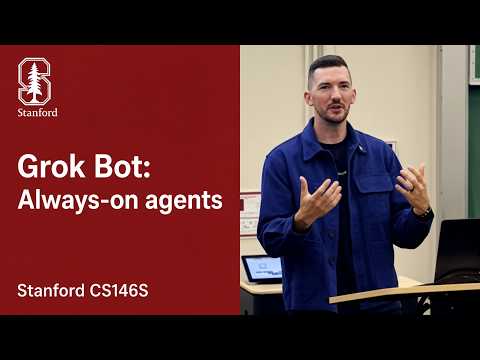
A very small standalone team built an internally usable version from scratch in 4 weeks and shipped it publicly 3 weeks later.
They deliberately built Grok Bot as a standalone product instead of adding it inside Cursor (chapter 08:40).
The team personally hand-onboarded nearly 300 early users (chapter 11:20).
Two early decisions: fully cloud, and each bot gets its own computer; plus a “colleague-pilled” idea — hide the internals so delegating a task feels like handing it to a colleague (chapters 14:29, 30:02, 39:20).
They also talk about Grok Bot as an always-on information filter and “chief of staff” (幕僚长), and say the moat was discovered, not planned (chapters 51:04, 1:11:45).
An always-on agent runs on a server, so closing your laptop, restarts and crashes don’t stop it; it has its own cloud Linux computer, builds up memory, knows when to stay quiet, and can be woken by Slack messages, email or other events (chapters 00:00, 02:34).
Architecture: the server and the computer sleep and wake as needed; the computer is a Firecracker VM that can be snapshotted, and the agent loop lives on the server, not the VM; durable workflows on Temporal mean a retry after a failure resumes at the failed step (chapters 10:04, 14:05).
Harness: the only tool between client and server is “send to user”; tools are discovered on demand with only their names in context; the agent tries conversation memory, plugins/MCP, search, the browser and the full desktop before bothering the user; sub-agent helpers keep the main conversation sparse (chapter 18:06).
Safety and context: auto review has a separate model check every shell command, irreversible actions like sending email ask the user first; a static prompt prefix keeps the prompt cache warm, long outputs go to files, and compaction runs while the cache is still warm; memory is layered into core user facts, dated logs and ephemeral scratchpad notes (chapters 27:24, 32:50).
Flywheel and outlook: failures become evals, the harness gets fixed, and new models train on them; the Cursor and SpaceX principle is to “delete the product” and build for the next model generation; he expects agents to work for weeks or months soon, and says evaluating a month-long agent when models ship monthly is still unsolved (chapters 34:29, 37:43).
Instinct
Founder interview. No other Instinct founder or team-member video interview found.
There is no app: Instinct has its own phone number and computer. Users text, call, or email it, and it can call them back.
Invite-only, about 10% daily growth, with no marketing spend (from the podcast show notes).
How long it takes users to trust an agent with a credit card, inbox, and calendar; an “Instinct to Instinct” trust network lets two people’s agents coordinate directly.
Business model: no ads, a take rate, and more than $1 billion in annual GMV flowing through the platform (from the podcast show notes).
Compute is the biggest challenge — he says he spends 40% of his time on it — and he also talks about Muse (podcast chapter 01:02:30).
还谈到怎么建立用户对 agent 的信任、扎克伯格对产品的执着,以及在 Meta 重建 AI 实验室。
Key takeaways
It started with OpenClaw: Nat Friedman used it deeply inside MSL first; Wang followed, and his first use was a deep self-analysis he compared to “three years of therapy” (三年心理治疗).
A first prototype existed in February, already with many Muse elements; they then spent 7 months turning a prototype that was occasionally magical and usually broken into a reliable consumer product.
Why personal agents instead of coding: early in the year Anthropic led coding by a wide margin, and the industry treated coding agents as the only thing that mattered; Meta decided personal and consumer AI was where it could make something distinctive.
A good product needs a “single point of view” (单一视角); on Muse he says the clearest one is Nat Friedman’s. He also talks about using memes to help the product spread.
He also covers how to build user trust in an agent, Zuckerberg’s product obsession, and rebuilding Meta’s AI lab.
眼镜会成为纯多模态的 agent 入口;他们也认为 AI 不会赢者通吃(章节 01:20:06、01:34:06)。
Key takeaways
They open with viral Muse uses, including Wang having his Muse source uncommon teas each week from small farms in Taiwan and Japan (chapter 00:24).
“The model is the product”: the product layer gets thinner and the model looks more like the product itself; a lot of Muse product work is on privacy and safety models.
The new Muse Wonder model is trained end-to-end for personal and professional agents, with a focus on “active memory,” which they treat as a requirement for a reliable agent.
Agentic commerce: demand will gradually move from existing channels to agent channels, the way e-commerce moved demand from physical stores.
Glasses become a fully multimodal agent entry point; they also argue AI will not be winner-take-all (chapters 01:20:06, 01:34:06).
Anthropic · (Taipei) · team lead Karan Ahuja (named in article)
中文摘要Anthropic 正式介绍 Claude Duet:面向专业人士与小企业主的主动式个人 agent 研究预览。它用 Claude Opus 5.5,早间发简报、在你离开后继续用云端虚拟机和浏览器干活,并在代发消息、付款、签字或删除前征求确认。美国 Pro / Max 用户可排队;计入同一用量上限;独立 iOS / Android App,也可在 claude.ai 使用。团队负责人是 Karan Ahuja。
EnglishAnthropic introduces Claude Duet, a research-preview proactive personal agent for professionals and small business owners. Built around Claude Opus 5.5, it sends a morning brief, keeps working in a cloud VM with its own browser when you step away, and asks before sending, paying, signing, or deleting. US Pro and Max subscribers can join the waitlist; usage shares the plan’s Claude limits. Available as a standalone iOS/Android app and on claude.ai. Team lead named in the article: Karan Ahuja.
Key points
研究预览:美国 Pro / Max 排队;独立 iOS / Android App + claude.ai;计入 Pro / Max 同一用量(后台巡检也算)。
中文摘要42章经对话 Ambi 创始人子皓。他认为从 OpenClaw 到 Muse,真正变化是普通人终于能「像用移动互联网产品一样」用上 Personal Agent;Ambi 走软硬结合,补齐线下上下文与交互入口,把「每轮都要复述背景」的摩擦压下去。他反对人格化助手路线,主张 AI 是用户自身的延伸;主动性应来自环境感知,而不是扫 connector 瞎猜。硬件渠道与独占性可能比纯软件更容易形成壁垒。
English42ZhangJing talks with Zihao, founder of Ambi (ex-Plaud China CEO). He sees the OpenClaw-to-Muse arc as the moment personal agents become usable like consumer apps, and argues Ambi should win with hardware-software context that cuts the friction of re-explaining every turn. He rejects personified-assistant branding in favor of AI as an extension of the self, and wants proactivity from sensing the user's environment rather than scanning connectors.
中文摘要Founder Park 对话 Karpo 创始人 Leah(98 年,豆包早期成员)。Karpo 是专注晚上、周末和假期生活体验的 Personal AI,主打海外市场。Leah 认为通用赛道属于大厂,创业公司要在需求成形前捕捉意图,她称之为“意图前插的竞争”。
EnglishFounder Park talks with Leah, the founder of Karpo, a lifestyle-focused personal AI that helps users find great places for evenings, weekends and trips. She argues that general agents belong to big tech, so startups should win by capturing user intent before a need is fully formed.
Key points
Agent 分两类:取代人的“代替人”适合模型厂商,替你办事的“代理人”留给创业公司机会。
走垂直,体验才能做完整,也能更早建立数据飞轮(recursive)。
例子:约 30% 用户连接 Apple Music,Karpo 按音乐品味推荐酒吧,匹配的是 vibe。
EnglishLatePost interviews Today AI, founded by Teambition creator Qi Junyuan, one of the first Chinese companies to ship a general personal agent. The team argues that proactivity, built on personalization, is the core value, and that long-term usage data and switching costs will be the moat.
中文摘要Z Potentials 深度拆解 Instinct:把个人 AI 助理做成短信、iMessage 和电话里的“联系人”,后台用云端电脑、浏览器和已连接服务替用户订餐厅、办签证、追退款。文章认为资本押注的是个人 Agent 入口与私人上下文,但信任、授权和单位经济仍未被验证。
EnglishZ Potentials breaks down Instinct, an app-less personal agent that lives in SMS, iMessage and phone calls and uses a cloud computer, browser and connected services to book restaurants, file visas and chase refunds. It argues that investors are pricing in ownership of the personal-agent entry point and private context, while trust, permissions and unit economics remain unproven.
EnglishTencent Tech argues that the real shift behind the personal-agent wave is toward always-on agents that are proactive, hold permissions and keep memory, not just a pivot toward people. It traces the spectrum from Claude Code to OpenClaw, Hermes and Grok Bot, using Grok Bot's architecture to show how wake-ups, crash recovery, approvals and memory are being solved.
Software meant to stay with one person and act on their behalf — remember context, take initiative, and do work — instead of only answering a prompt. Chatbots reply; personal agents are supposed to keep going. This page is a personal curated reading list, not an official catalog or ranking.
Personal agent vs AI assistant / chatbot?
On AItier, “AI assistant” means a specific always-on product (dots, Meta Muse, Grok Bot, Cue…) — not the underlying model. A chatbot is typically a session you open and close. A personal agent is designed to persist: permissions, memory, proactivity. Rank the products on the AI assistants board. This reading list is not that board.
What are always-on agents?
Agents that stay running so they can wake on events (not only a timer), recover after a crash, keep memory, and ask you only at high-stakes steps like login or payment. The Tencent Tech card above maps that architecture — the author’s claims, not an AItier eval. Jump to that card.
How do I choose a personal AI agent?
AItier does not pick a winner. Read the summaries here, then make a personal S–F poster of assistant products on the AI assistants board and export a PNG. That list is yours, not official.
What is Claude Duet, Instinct, Muse, and Grok Bot?
Personal-agent products: Claude Duet is Anthropic’s proactive personal agent (research preview 21 Oct 2026, US Pro/Max waitlist); Muse is Meta’s personal agent (8 Sep 2026); Instinct is Noah Shinn’s app-less agent in iMessage, SMS and phone calls; Grok Bot is Cursor/xAI’s always-on personal agent. Labels follow public coverage (including Anthropic’s Duet article and Tencent Tech here), not an AItier eval. Interviews & videos. Rank them on the AI assistants board.
Where are the interviews and videos from?
Founder, team, and official YouTube interviews only, grouped by Claude Duet, Grok Bot, Instinct and Muse — speaker name and role as verified, date, length, and our CN+EN takeaways. No creator reviews. Thumbnails and titles link to YouTube; embeds load only if you click. Not official product pages, not AItier-hosted. Jump to that section.